
How Partners Track Staff Work in a CA Firm Without Micromanaging
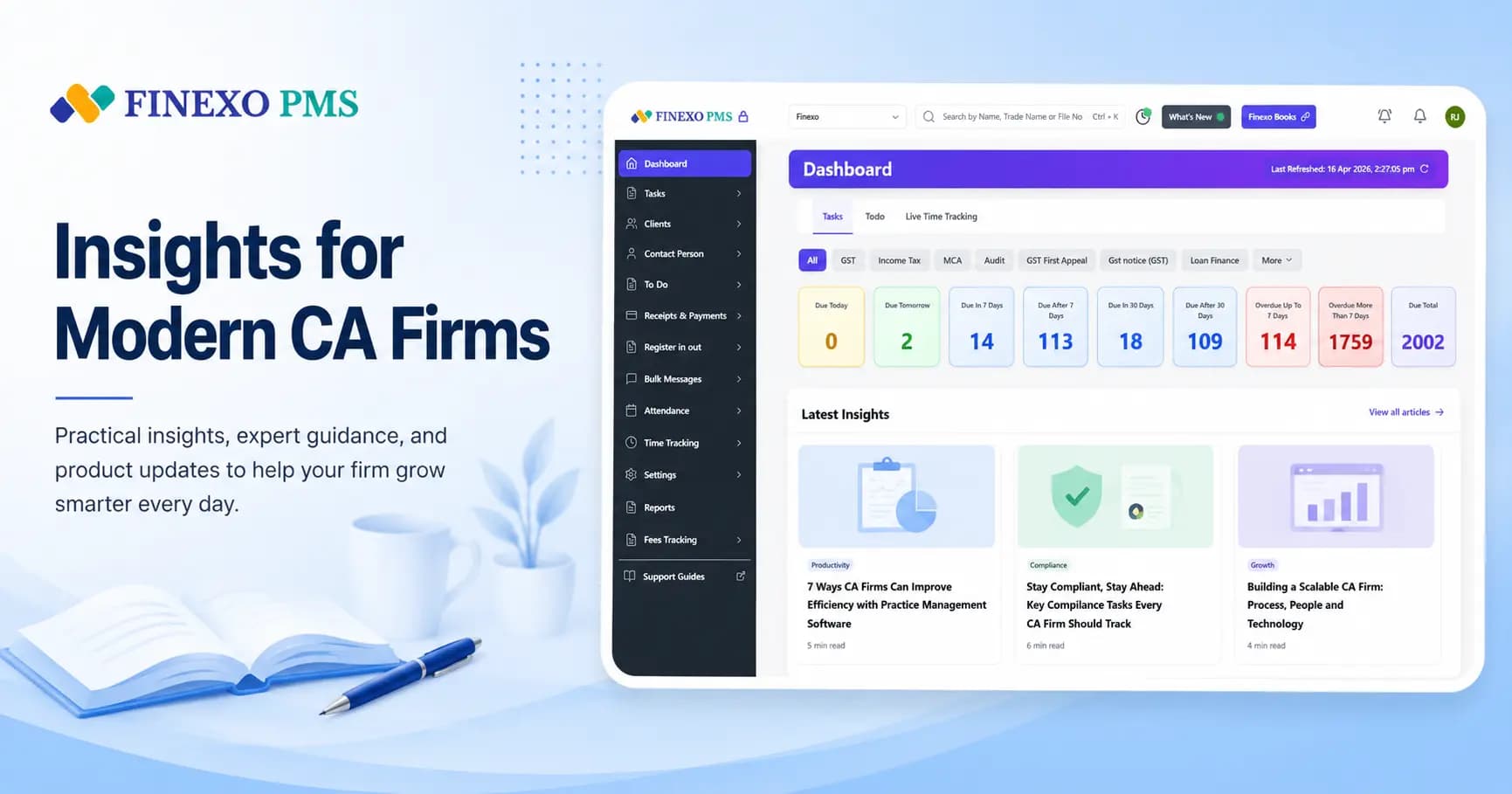
Partners in a CA firm track staff work by making every piece of client work a task with one named owner and a due date, then reading a single dashboard that shows pending and overdue work by person — not by asking people what they are doing. The visibility comes from the work being recorded once, at assignment, rather than from status meetings, daily reports or looking over shoulders.
The reason most firms fail at this is not laziness. It is that the work is invisible by default. A GST filing, an ITR, a scrutiny reply and an audit section all live in someone's head and in a WhatsApp thread. A partner asking "what's pending?" gets an honest answer that is also incomplete, because the person answering is recalling rather than reading.
Why "how is that client going?" is the wrong question
Asking individuals for status has three failure modes, and every growing firm hits all three:
- It scales with partner time, not firm size. Twenty employees means twenty conversations, and the partner becomes the bottleneck in a system meant to remove bottlenecks.
- It surfaces the loud work. People report what they are actively doing. The item nobody has started is exactly the item that will be missed, and it is the least likely to come up.
- It reads as distrust. Repeated status questions feel like surveillance even when they are not meant that way, and the response is defensive summarising rather than accurate reporting.
The alternative is not more reporting. It is fewer questions, because the answer is already on a screen.
The four things a partner dashboard has to show
| View | Question it answers |
|---|---|
| Overdue by person | Who is behind, and by how much — before the client calls |
| Open work by person | Who is overloaded and who has capacity, so reallocation is a fact not a guess |
| Unassigned work | What has no owner at all — the single most reliable predictor of a missed deadline |
| Work by client | Whether a client relationship is at risk across all their compliance, not one filing |
A firm that can answer those four questions in under a minute has solved staff visibility. Everything beyond it — time entry, utilisation percentages, effort variance — is refinement, and refinement added before the basics are in place usually collapses within a quarter because nobody keeps the data clean.
Work allocation: assign at creation, not at crisis
- Default owners on the client master. If Client A's GST work always goes to a particular executive, the system should assign it automatically rather than waiting for a human decision each month.
- Assign the moment the task exists. An unassigned task is a task nobody is doing. Firms that allow an "unassigned" pile always find their misses in it.
- Reallocate from the workload view, not from memory. When someone is out, moving their open items should take one filtered screen and a bulk reassign.
- Escalate on age, not on complaint. A task that has been open past its due date should raise itself to the partner automatically. Waiting for a client to escalate is not a system.
Measuring productivity without poisoning the culture
This is where firms overreach. The instinct after installing a dashboard is to rank staff by tasks closed, and it backfires quickly: people take easy work, split tasks to inflate counts, and stop flagging problems. Task volume is not output — a single complex assessment reply can be worth thirty routine filings.
What works better is measuring the firm, not the individual. Track the percentage of filings closed before the due date, the number of items that ever went overdue, and the count of work that sat unassigned. Those numbers improve when the process improves, and staff are willing partners in fixing them because no individual is on trial. If you do want per-person data, use it for capacity planning and conversations about support, not for scorecards.
Chartered accountants running larger teams generally arrive at the same conclusion described in our 500+ client operations guide: visibility is a management tool, and the moment it becomes a performance weapon the data stops being trustworthy.
What this looks like in software
Finexo's task engine creates GST, ITR and TDS work from each client's own profile, so every item exists with an owner before anyone has to think about it, and partner dashboards show overdue and open work by person, by client and by compliance type. That is the whole mechanism: record the work once, at the point it is created, and let the reporting be a by-product rather than a separate chore.
If your firm is still allocating from a shared spreadsheet, the symptoms in 15 signs your CA firm has outgrown Excel will be familiar — staff visibility is usually the first one partners feel.
A review cadence that replaces the status meeting
Dashboards do not manage a firm; they make managing it cheap. What partners need is a rhythm short enough that nothing rots and light enough that nobody dreads it.
| When | What is read | Decision it produces |
|---|---|---|
| Daily, two minutes | Unassigned work, and anything overdue since yesterday | Assign it. Nothing else. |
| Weekly, twenty minutes | Open work by person, overdue by person, work due in the next ten days | Reallocate load; decide which clients need a call before they call you |
| Monthly, one hour | Filings closed before due date, items that ever went overdue, time sat unassigned | Fix a process, not a person |
| Quarterly | Work by client across all compliance areas; realisation on fixed-fee clients | Scope, fee and staffing conversations |
The daily check is the one firms skip and the one that pays. Unassigned work is the highest-yield signal available — it takes seconds to read, and almost every missed deadline in a growing practice spent time in that state first.
What to actually do when the dashboard shows a problem
Visibility creates a new failure mode: partners who can see everything and respond to all of it, which is just the old bottleneck with better data. The response should depend on what the pattern is, not on how alarming it looks.
- One person is consistently overdue. Look at their open count before concluding anything about them. Overload and capability produce identical dashboards, and only one of them is fixed by a conversation about performance.
- The same client is late every cycle. That is usually a client behaviour problem — documents arriving on the 18th — not a staff problem. The fix is the chase schedule or the engagement terms, and no amount of reassignment touches it.
- One compliance type is always behind. The task logic or the process for that type is wrong. TDS quarters and annual returns are the usual offenders because they fall outside the monthly rhythm the team has internalised.
- Everything is late in one week of the month. That is capacity, not discipline. Either work starts earlier in the cycle or the firm has taken on more than it can file.
- The dashboard is clean but clients are complaining. The data is not being maintained. Tasks are being closed to clear the board rather than because the work is done, which is what happens when the board is used to judge people.
Multi-branch and remote teams
Everything above gets harder when the team is not in one room, and firms with two offices often discover their visibility was never systematic — it was proximity. Three things change:
- Assignment has to be explicit. In a single office, work gets picked up by whoever is free. Across branches nobody sees who is free, so unassigned work sits indefinitely rather than being absorbed.
- Access has to follow the client, not the office. Branch-level silos are how a client's GST history ends up unavailable to the person handling their notice. Access set by client assignment travels with the work.
- The dashboard has to filter both ways. Partners need firm-wide totals and per-branch views, or one office's problems disappear inside the other's numbers.
The same requirements apply to staff working from home during filing weeks, which is now normal in most practices. If the work is only visible when someone is physically present, the firm has an attendance system rather than a work system.
Time tracking: when it is worth the friction
Partners who install a dashboard almost always ask about time tracking next, and the honest answer is that it is worth it for some firms and actively harmful for others. It earns its keep when you bill hourly, when you need realisation data on fixed-fee clients whose scope has drifted, or when you are deciding what to price differently next year. It does not earn its keep as a proxy for effort or attendance — timesheets filled in on Friday for the whole week are fiction, and fiction entered under obligation is worse than no data.
If you do introduce it, introduce it for a purpose people can state, on a subset of work, after the basic visibility layer is stable. Firms that add time tracking in the same month as task management usually end up with neither, because the team associates the whole system with paperwork. The team management view — who has what, and how much — answers most capacity questions without any timesheet at all.
Where this fits in a growing practice, including when to create portfolio owners below partner level, is covered in how to grow a CA practice. If you are still choosing a system, how to choose practice management software and the comparisons hub cover the options, and CRM vs practice management software is worth reading first if you are unsure which category you need.
Bottom line
Partners do not need to know what every employee is doing right now. They need to know what is late, what has no owner, and who is buried — three facts a system can produce for free once work is captured properly. Firms that chase that through meetings and status updates end up with less information and more friction than firms that simply write the work down in one place.
Frequently Asked Questions
How do partners know what staff are working on in a CA firm?
Through a task-based system where every client job has a named owner and a due date, feeding a dashboard that shows overdue work, open work by person, and unassigned items. Partners read the dashboard instead of asking for status, which scales as headcount grows and surfaces work nobody has started.
What is the best software for team management in accounting firms?
Practice management software with automatic task creation, default owners on the client master, bulk reassignment, and partner dashboards filtered by person and by client. For Indian chartered accountants and tax consultants, the tool also has to understand GST, ITR and TDS work so that tasks appear without being created manually.
How can a CA assign work to employees efficiently?
Set default owners at the client level so recurring compliance work routes itself, assign every task at the moment it is created, reallocate from a workload view rather than from memory, and let overdue items escalate to a partner automatically instead of waiting for a client complaint.
Should CA firms monitor employee productivity with software?
Measure the firm rather than the individual. Percentage of filings closed before the due date, count of items that went overdue and count of unassigned work are honest process metrics. Ranking staff on tasks closed encourages people to take easy work and split items, and it makes the data less reliable.
How can a CA firm reduce missed deadlines?
Eliminate unassigned work, generate recurring statutory tasks automatically instead of relying on someone to create them, and put an automatic escalation on any item that passes its due date. Most misses trace back to work that existed only in someone's head rather than to genuine capacity shortfalls.